Fifteen Minutes That Should Have Been a Triumph
On the afternoon of August 26, 1944, the day after the German garrison surrendered, hundreds of thousands of Parisians packed the parvis of Notre-Dame. General Charles de Gaulle had just walked the length of the Champs-Élysées, from the Arc de Triomphe to Concorde, through the largest crowd Paris had ever assembled. The ceremony planned inside the cathedral — a Te Deum, the ancient hymn of thanksgiving sung after French victories for centuries — was meant to seal the Liberation.
Instead, as de Gaulle stepped through the great portal, gunfire erupted.
Bullets cracked from the upper galleries, ricocheting off the medieval vaults and sending stone splinters onto the congregation below. People threw themselves behind pillars and under chairs. And in the middle of the nave, one very tall man kept walking, upright, at the same unhurried pace, toward the choir.
To understand how Notre-Dame arrived at that surreal moment — packed, scarred, and under fire on the happiest day in its modern history — you have to go back five years.
September 1939: The Cathedral Prepares for War
When France declared war on Germany in September 1939, Paris braced for the bombing raids that had already devastated cities in Spain and Poland. At Notre-Dame, the most irreplaceable treasures were the ones you could see the sun through: the medieval stained glass, including the great rose windows, some of it dating back to the 13th century.
So it came down. Panel by panel, the upper windows and precious glass were carefully removed, crated, and evacuated for safekeeping far from Paris. Sandbags were piled around what could not be moved. Visitors to wartime Paris found a strangely pale cathedral, its luminous colors replaced by dull temporary glazing.
It was a wise precaution — and, in a bitter irony, the glass would end up being endangered less by German bombs than by bullets fired inside the cathedral on the day of its deliverance.
June 1940: An Open Church in an Occupied City
Paris fell on June 14, 1940, declared an open city to spare it destruction. The swastika went up over the Eiffel Tower and the Hôtel de Ville — but Notre-Dame never closed. Throughout the four years of Occupation, masses continued daily beneath the empty window frames.
The cathedral became, of all things, a tourist attraction for the occupiers. German soldiers on leave queued to visit it, cameras in hand, posing on the parvis like any peacetime visitor. When Adolf Hitler made his one and only visit to Paris in the early hours of June 23, 1940 — a whirlwind tour of the Opéra, the Madeleine, the Eiffel Tower, and Napoleon’s tomb at the Invalides — the cathedral was not judged worthy of a stop. The Führer’s Paris was a trophy to be photographed, not a sanctuary to be entered.
A Cathedral Caught in Vichy’s Embrace
The war years placed Notre-Dame’s clergy in an increasingly compromising position. The Archbishop of Paris, Cardinal Emmanuel Suhard, followed the line of much of the French Catholic hierarchy: accommodation with Marshal Pétain’s Vichy regime.
Under Suhard, Notre-Dame hosted ceremonies that aged very badly, very quickly. In April 1944, when Pétain made his only wartime visit to Paris, he attended a solemn service at the cathedral for the victims of Allied bombing raids — greeted on the steps by the Cardinal himself, before an enormous crowd. Weeks later, Suhard presided over the funeral of Philippe Henriot, Vichy’s propaganda minister, assassinated by the Resistance in June 1944.
Paris would remember. So would de Gaulle.
August 1944: The Cathedral’s Fate Hangs on One Man
As the Allies broke out of Normandy and the Paris insurrection began, Hitler issued his infamous order: the city was to be defended to the last man and left to the enemy only as “a field of ruins.” Bridges were mined. Explosives were positioned at landmarks across the capital. Whether Notre-Dame would survive the week depended largely on whether the German commander of Greater Paris, General Dietrich von Choltitz, would obey.
He did not — a story we tell in full in our article on the man who refused to burn Paris.
On the evening of August 24, when Captain Dronne’s vanguard of Leclerc’s 2nd Armored Division reached the Hôtel de Ville, the churches of Paris announced the news the only way they could: their bells rang out one by one across the rooftops, until the deep voice of Emmanuel, Notre-Dame’s massive 17th-century bourdon, joined them. German soldiers still holding positions in the city asked what the sound meant. It meant it was over.
You can read the full story of that week — the barricades, the truce, Leclerc’s race to the capital — in our article on the Liberation of Paris.
August 26: The Te Deum Under Fire
The next day’s ceremony at Notre-Dame was pure political theater, and de Gaulle knew exactly what he was staging: the restoration of the French state, blessed in the nation’s parish church.
One man was pointedly absent. De Gaulle refused to allow Cardinal Suhard — who had welcomed Pétain at the same cathedral four months earlier — to receive him at the door of his own cathedral. The Archbishop of Paris spent the Liberation’s thanksgiving service confined to his residence. It was a public humiliation of the Catholic hierarchy, and an unmistakable message about who now spoke for France.
At the cathedral, de Gaulle arrived with General Leclerc and the leaders of Free France and the Resistance. And then, as the party entered the nave, the shooting started — from the upper galleries inside the building, and around the parvis outside.
A BBC correspondent, Robert Reid, was standing at the west door with his recording gear and captured the whole thing live — the gunfire, the screams, the crowd surging — in one of the most famous pieces of audio journalism of the war. Knocked off his feet in the crush, he got up and kept describing what he saw: de Gaulle walking straight down the nave “as though nothing had happened.”
Inside, the clergy pressed on. The Magnificat rose under the vaults while bullets ricocheted off the stone — witnesses wrote that no Magnificat was ever sung more fervently or more quickly. Several people in the congregation were wounded. After roughly fifteen minutes, the ceremony was cut short; the full Te Deum was never completed.
De Gaulle never ducked. Eyewitnesses across the political spectrum agreed on that point, and the image — the towering general standing exposed in the choir while all of Paris crouched — did more for his authority than any speech. As he later wrote of the moment, with characteristic understatement, it seemed to him that the crowd’s fear would pass. It did.
Who Fired? The Mystery Nobody Solved
Police who climbed into the galleries found armed men who claimed they had been shooting at “indistinct enemies.” Were they German stay-behind snipers? Miliciens — French collaborationist paramilitaries — firing in desperation? Trigger-happy FFI fighters responding to a first accidental shot, in a city where everyone was armed and no one had slept?
More than eighty years later, historians still don’t agree. No shooter at Notre-Dame was ever identified, tried, or even formally arrested. The same phantom gunfire had erupted at Concorde and along the Champs-Élysées that afternoon, and it remains one of the enduring small mysteries of the Liberation.
What is certain is the damage: among the casualties of August 26 were several of the cathedral’s remaining windows, shattered not by the Luftwaffe or the RAF, but by gunfire on the day of victory.
The Glass Comes Home
The evacuated medieval glass survived the war intact in its crates. Restoring it was slow, careful work — the rose windows and ancient panels returned over the years that followed, the restoration continuing well into the post-war decades.
Notre-Dame had made it through the Second World War the way it has made it through most things in 860 years: scarred, but standing. Parisians of 1944 could hardly have imagined that the cathedral’s greatest peril would come not from a world war, but from a fire on an April evening in 2019 — or that it would rise from that too.
Stand Where de Gaulle Stood
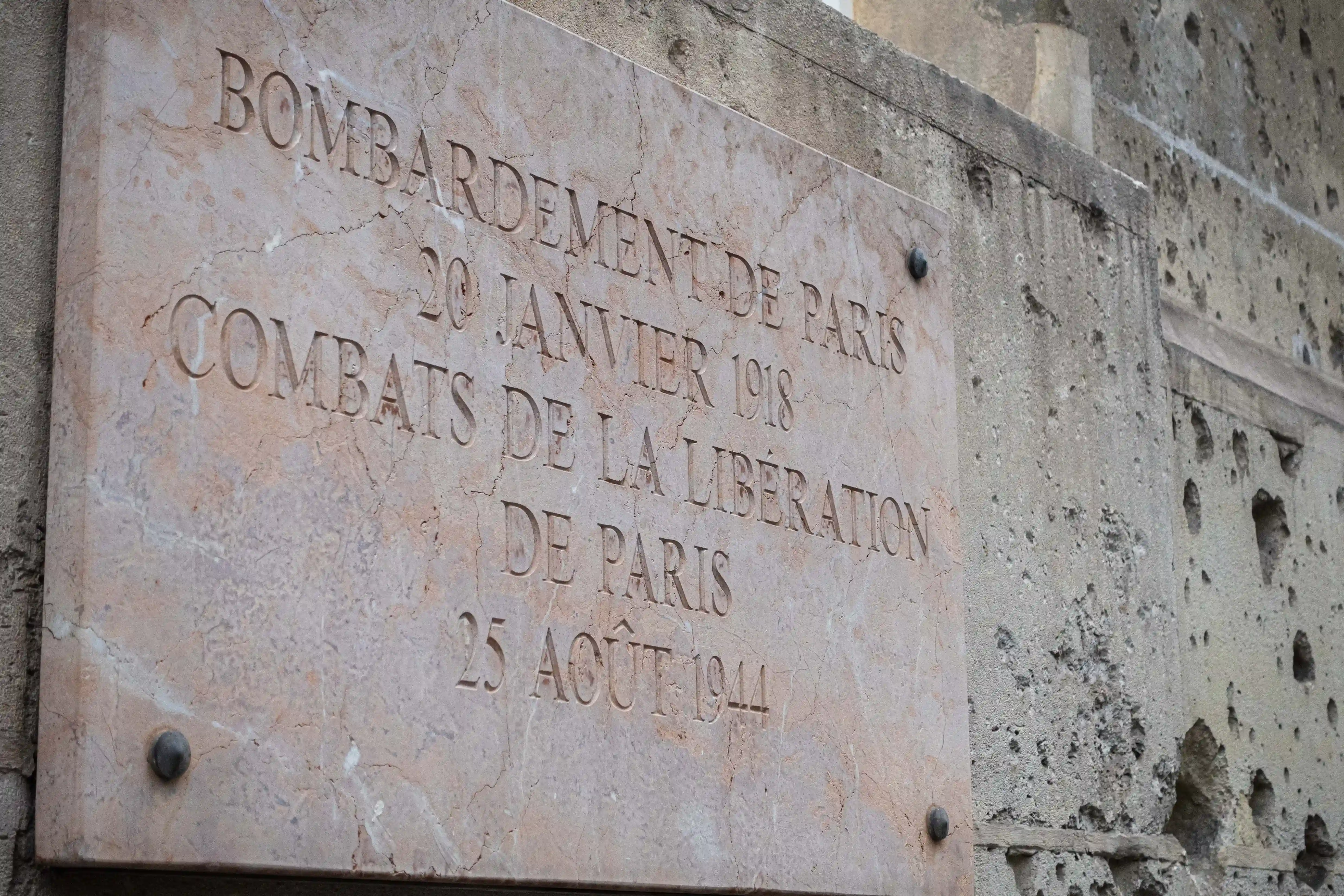
Notre-Dame is the final stop of our Left Bank WWII walking tour. We finish on the parvis, where the crowd gathered on August 26, 1944 — and where, if you know where to look, the neighborhood still carries the bullet scars of Liberation week. It is one thing to read about the Te Deum under fire; it is another to stand in the exact spot and hear it told.
Walk the story from the Sorbonne to Notre-Dame — Book a WWII tour in Paris.
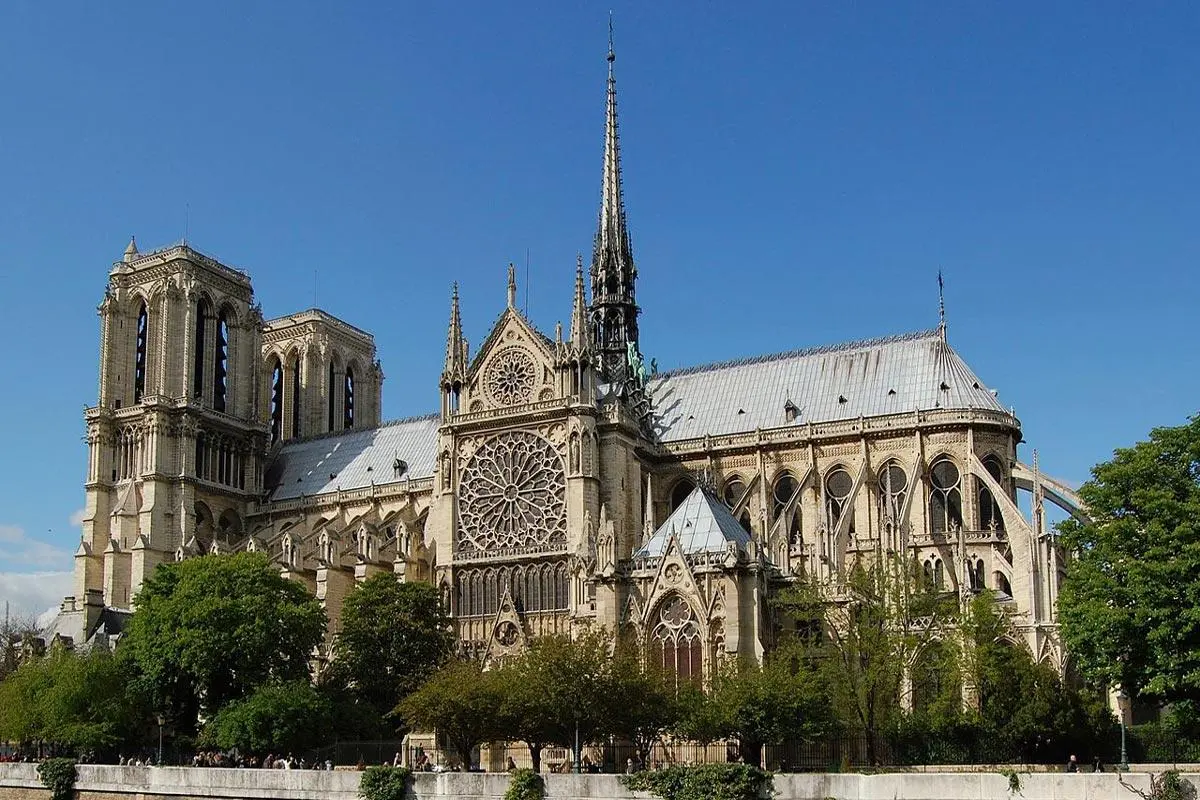
Photo: Notre-Dame de Paris. Personal photograph, Paris History Tours.