Why “Gestapo” Is the Wrong Word, and Why Everyone Used It
Ask a Parisian who lived through the Occupation where the Gestapo was, and you would get a dozen different answers. All of them would be right in their way. “La Gestapo” was what Paris called every German police service that arrested people, and every French gang that did the same work for them.
Strictly speaking, the Gestapo was one section among several. In June 1940, a small team of about twenty men of the German security police, the Sicherheitspolizei and the SD, arrived in the capital under a young SS officer, Helmut Knochen. At first the German army, which governed occupied France from the Hôtel Majestic, kept them on a short leash. In 1942, Berlin sent Carl Oberg, an SS general, to take charge of all police matters in France. From then on, the security police grew, spread across a dozen requisitioned buildings, and relied on something it could not do without: the French police, and French auxiliaries willing to inform, follow and arrest.
The result is a map of the city that most visitors never see. No museum, very few plaques, buildings that are now ministries, embassies and private flats. Here are the addresses that matter, what happened in each, and what you can still see.
11 rue des Saussaies: the Gestapo Itself (8th)
Where: 11 rue des Saussaies, 8th arrondissement, behind the Élysée Palace. Métro Miromesnil or Champs-Élysées–Clemenceau.
This is the address closest to the textbook meaning of the word. The building belonged to the French Sûreté nationale; the Germans took it over and installed Section IV, the Gestapo proper, under Karl Boemelburg. People arrested in Paris for resistance were brought here to be interrogated, sometimes for days, before being sent on to the prisons of Fresnes or the Cherche-Midi.
Today the building is part of the Ministry of the Interior, which makes the irony hard to miss: it went back to the French police in 1944 and has stayed with them ever since. A plaque on the façade recalls the resistance fighters who were held and tortured inside, and the inscriptions they scratched on the walls of their cells have been preserved.
What you see: the plaque, from the pavement. The cells are inside a working ministry and are not open to the public.
Avenue Foch: the Headquarters District (16th)
Where: avenue Foch, 16th arrondissement, between the Arc de Triomphe and the Bois de Boulogne. Métro Porte Dauphine, RER C Avenue Foch.
The widest avenue in Paris, lined with private mansions, became the nerve centre of the German police. The senior officers wanted the 16th arrondissement: quiet, wealthy, full of large houses whose owners had fled. Parisians soon nicknamed the avenue avenue Boche.
- 72 avenue Foch was the headquarters of Helmut Knochen, commander of the security police and SD for France.
- 84 avenue Foch housed its counter-intelligence section, under Hans Josef Kieffer, whose job was to destroy the British secret service networks, the SOE, and the French resisters who worked with them. Captured agents were questioned there and held in the former servants’ rooms under the roof.
- 31 bis avenue Foch is the address given for the office of the section in charge of “Jewish affairs”, whose head in 1941 and 1942, Theodor Dannecker, prepared the round-ups in Paris with the French authorities, including the Vel’ d’Hiv round-up of July 1942.
Two stories from number 84 say more than any organisation chart. In November 1943, the SOE radio operator Noor Inayat Khan, held on the top floor, tried to escape across the roofs with two other prisoners; they were caught in the street below. She was later deported and murdered at Dachau in September 1944. And on March 22, 1944, Pierre Brossolette, one of the leaders of the Resistance, who had been identified after weeks in a prison in Rennes under a false name, was left alone for a moment in a fifth-floor room. He threw himself from the window rather than risk giving names. He died that evening in hospital.
A few streets away, 57 boulevard Lannes was the residence and office of Carl Oberg, the man at the very top.
What you see: elegant, anonymous façades. Number 84 has no plaque. Walking the avenue from Porte Dauphine towards the Arc de Triomphe takes about twenty minutes, and it is precisely the absence of any sign that makes the walk worth doing.
93 rue Lauriston: the “French Gestapo” (16th)
Where: 93 rue Lauriston, 16th arrondissement. Métro Boissière or Victor Hugo.
If one address still makes older Parisians lower their voice, it is this one. From 1941, a gang of French criminals worked here for the German police: informing, arresting, looting and torturing. Its leader was Henri Lafont, a petty criminal the Germans had released from prison in 1940; his deputy was Pierre Bonny, a police inspector dismissed before the war, who brought the methods and the files of a professional. Parisians called them la Carlingue, the “French Gestapo of rue Lauriston”.
The gang made fortunes on the black market and in requisitioned goods, rubbed shoulders with German officers and Parisian celebrities, and hunted down resisters, whom it interrogated in the basement. Its members were among the first collaborators tried at the Liberation: Lafont and Bonny were shot at the fort of Montrouge in December 1944.
What you see: an ordinary residential building. A plaque now recalls the resistance fighters tortured inside.
180 rue de la Pompe: a Gang to the Very End (16th)
Where: 180 rue de la Pompe, 16th arrondissement. Métro Rue de la Pompe.
The rue Lauriston gang was not the only one. In 1944, a German agent, Friedrich Berger, ran a group of French auxiliaries from this address. In the last months of the Occupation, as the Germans grew desperate, the “Gestapo of the rue de la Pompe” arrested, robbed and tortured resisters in the building until the very eve of the Liberation, in August 1944.
What you see: another quiet street in the 16th. Without the address, you would walk past.
Not the Gestapo, but Part of the Same System
Some of the most famous wartime addresses in Paris belonged to other German services. They are worth knowing, if only to read the city correctly.
- Hôtel Majestic, 19 avenue Kléber (16th): the seat of the German military command in France, the Militärbefehlshaber in Frankreich. Today, the Peninsula hotel.
- Hôtel Meurice, rue de Rivoli (1st): the headquarters of the military governor of Greater Paris. In August 1944, it was the office of General von Choltitz, who chose not to destroy Paris.
- Hôtel Lutetia, 45 boulevard Raspail (6th): the Abwehr, the army’s military intelligence, the rival of the SD. From April 1945, it became the reception centre for deportees returning from the camps, where families waited with photographs.
The prisons completed the system: Fresnes, south of Paris, where the walls of some cells still carry prisoners’ inscriptions; La Santé; and the Cherche-Midi military prison, demolished in 1966, where Agnès Humbert of the Musée de l’Homme network was held. From there, the road led to the execution posts of the Mont-Valérien, where 1,008 people were shot, or to the transit camp of Drancy.
What Happened to the Men
Knochen and Oberg were arrested after the war and handed over to France. They were tried together in Paris and sentenced to death in 1954. Their sentences were commuted, and both men were released in 1962. Kieffer, of avenue Foch, was hanged by the British in 1947 for the murder of captured SAS soldiers. The French auxiliaries fared worse than their masters: Lafont and Bonny had been shot within four months of the Liberation, nearly ten years before the German police chiefs came to trial.
Seeing It for Yourself
The addresses of the 16th arrondissement can be walked in about an hour and a half: start at the Hôtel Majestic on avenue Kléber, take the rue Lauriston to number 93, cross place Victor-Hugo to the rue de la Pompe, and finish on avenue Foch towards Porte Dauphine. Then take RER C or line 1 to the Mont-Valérien, in Suresnes, and book the free guided visit: it is the place where the story of these buildings ends.
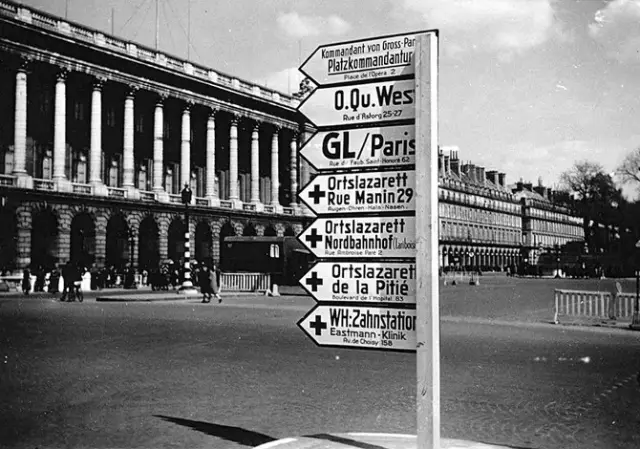
These addresses sit outside our tour routes, but the system they belonged to is at the heart of both. On the Right Bank WWII tour, we stand in front of the Hôtel Meurice and on the Place de la Concorde, where the German signposts in the photograph above once stood. On the Left Bank tour, or with the self-guided audio tour, we follow the Resistance networks that these services spent four years trying to destroy.
For the wider context, see the complete timeline of the Occupation, daily life in occupied Paris and our guide to the traces of the war still visible in the city.
Questions
- Where was the Gestapo headquarters in Paris?
- There was no single building. The Gestapo proper (Section IV of the security police, under Karl Boemelburg) worked from 11 rue des Saussaies, in the 8th arrondissement, today the Ministry of the Interior. The commanders of the whole security police were in the 16th: Helmut Knochen at 72 avenue Foch and Carl Oberg at 57 boulevard Lannes.
- What happened at 84 avenue Foch?
- It housed the counter-intelligence section of the security police, which hunted British SOE agents and their French networks. Prisoners were interrogated there and held in the rooms on the top floor. Noor Inayat Khan tried to escape across its roofs in November 1943, and Pierre Brossolette fell to his death from one of its windows in March 1944.
- What was the "French Gestapo" of rue Lauriston?
- A gang of criminals and dismissed policemen recruited by the Germans, led by Henri Lafont and Pierre Bonny, which operated from 93 rue Lauriston in the 16th arrondissement. It hunted resisters, ran black-market operations and tortured prisoners in the building. Lafont and Bonny were tried and executed in December 1944.
- Can you visit these places today?
- Mostly from the street: the buildings are private homes, offices or a ministry, and few carry a plaque. The places of memory that can be visited are the Mont-Valérien, where more than a thousand prisoners were shot, the Drancy memorial and the Mémorial de la Shoah.
Sources
- Jacques Delarue, Histoire de la Gestapo, 1962.
- Jacques Delarue, Trafics et crimes sous l'Occupation, 1968.
- Sarah Helm, A Life in Secrets: Vera Atkins and the Missing Agents of WWII, 2005.
- French Ministry of the Armed Forces, Le mémorial du Mont-Valérien, 2026.