Introduction
Visitors often ask me what happened in Paris during the occupation. The events are easy enough to list — I have written a full timeline of those four years elsewhere on this site.
But that is not really the question people are asking. What they want to know is what it was like. How did you buy bread? What happened if you were out after curfew? Did anyone go to the cinema? Did children still go to school?
Those answers are less dramatic than the roundups and the barricades, but they are the texture of the occupation. For most Parisians, most of the time, the war was not a gunfight. It was cold, hunger, queues, and the constant low-level calculation of how to get through another week.
German Time
The first thing the occupier changed was the hour.
Within days of entering the city in June 1940, the German authorities moved every clock in Paris forward to Berliner Zeit, Berlin time. It was an administrative decision, but Parisians experienced it as something stranger: the sun no longer rose when it used to. France never went back. The hour on your watch right now, standing in Paris, is the one the occupation imposed.
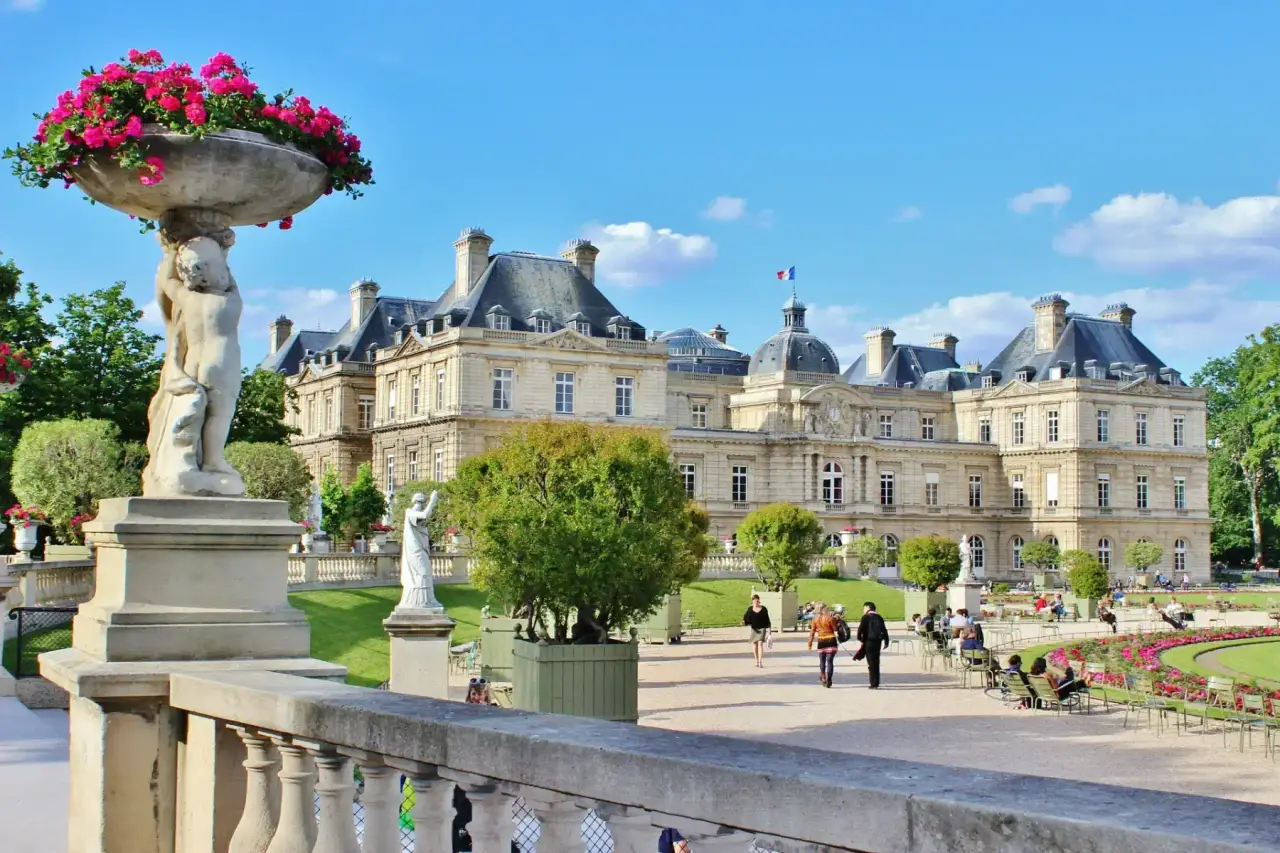
Then came the signs. Large wooden directional panels in Gothic lettering appeared at the Place de la Concorde and the Opera, pointing German soldiers toward their barracks, their cinemas, their requisitioned hotels. The Palais du Luxembourg became the headquarters of the Luftwaffe in France. The Hotel Meurice housed the military governor. A Parisian walking to work passed all of it.
And then the curfew. Generally 11 PM to 5 AM, though it moved: after an attack on a German soldier, the authorities would pull it forward to 10 PM, or even to 6 PM as collective punishment for an entire arrondissement. Being caught outside meant arrest at best. The result was a particular Parisian reflex that lasted four years — the sprint for the last Metro, the calculation of how long it takes to walk home, the evening that ends abruptly at 10:30.
Twelve Hundred Calories a Day
Ration cards arrived in September 1940 and organized the next four years of existence.
Everyone was sorted into a letter. E for infants under three, J1, J2 and J3 for children and adolescents, A for adults, T for those doing heavy physical labor, V for anyone over seventy. The J3 card, for teenagers, became slang for “adolescent” and stayed in the language for a generation.
The official adult ration worked out to roughly 1,200 calories a day — about half of what an adult body needs, and considerably less than half of what it needs in an unheated apartment in February. By 1942 the bread ration was down to about 275 grams a day, and the bread itself had changed: gray, heavy, cut with whatever flour was available. Meat ran to roughly 180 grams a week in 1941, and then less.
What filled the gap were vegetables that had previously been fed to animals. The rutabaga and the topinambour — swede and Jerusalem artichoke — became the taste of the occupation, so thoroughly that a whole generation of French people refused to eat them for the rest of their lives. Coffee became roasted barley and chicory. Sugar became saccharine.
And the queue became a job. Women lined up outside shops before dawn, often before knowing whether the shop would have anything at all. Faire la queue consumed hours of every day, and the queue itself became the city’s real news network — the place where you learned who had been arrested, which shop had butter, what the BBC had said the night before.
One small detail says a great deal about the period: tobacco was rationed too, and the ration was reserved for men. Women who smoked traded for it, or did without.
The Black Market
Official rations did not keep people alive, so almost everyone broke the law to some degree.
At the bottom of the system was the colis familial, the family parcel: up to fifty kilos of food sent by rail from relatives in the countryside. Millions of them crossed France. If you had a cousin with a farm, you ate. If you were a Parisian with no rural family, you did not.
Above that was the marche noir proper, where prices ran five to ten times the official rate. A new class of profiteers emerged, known with real contempt as the BOF — beurre, oeufs, fromage, butter, eggs, cheese — shopkeepers who became wealthy in four years and were widely hated for it.
And at the top, the occupation had no food problem at all. Black market restaurants operated openly for German officers and the people who did business with them. Maxim’s ran under German patronage. At the Ritz, where Hemingway would famously arrive in August 1944, the kitchens kept working throughout. The gap between a requisitioned dining room on the Rue Royale and a queue on the Rue Mouffetard is, in a sense, the whole social history of the occupation.
A City Without Petrol
Private cars essentially disappeared. Fuel went to the occupier; vehicles were requisitioned or immobilized. The boulevards that had been choked with traffic in 1939 were suddenly quiet enough that Parisians noticed birdsong — a detail that appears again and again in diaries from the period.
What replaced the car was the bicycle, and the velo-taxi: a bicycle pulling a small passenger cab, pedaled by men who had been taxi drivers a year earlier. Bicycle theft became one of the most common crimes in Paris, and people carried their bikes up six flights of stairs rather than leave them in a courtyard.
The Metro absorbed everything else. Traffic nearly doubled, from around 760 million journeys in 1938 to more than 1.3 billion in 1943. Carriages were packed, lighting was reduced to a dim blue, and a number of stations were closed for the duration — several of which never reopened and remain ghost stations under the city today. The last train before curfew was the great daily deadline of occupied Paris.
The Winters
Parisians who lived through it tended to remember the cold before the hunger.
Coal went to Germany and to the occupation administration. What was left for civilians was a fraction of normal consumption, delivered late or not at all. Families closed off every room but one, and lived in that room. Offices kept working in overcoats. Chilblains — swollen, cracked hands and feet from prolonged cold — became so common among schoolchildren that teachers stopped remarking on them.
This is part of why public spaces filled up. The Metro was warm. The cinema was warm. The library was warm. Spending the afternoon somewhere heated was not entertainment, it was heating.
By the last winters, people were cutting trees in the Bois de Boulogne for firewood.
Paris Still Went Out
Here is the part that unsettles visitors, and it should.
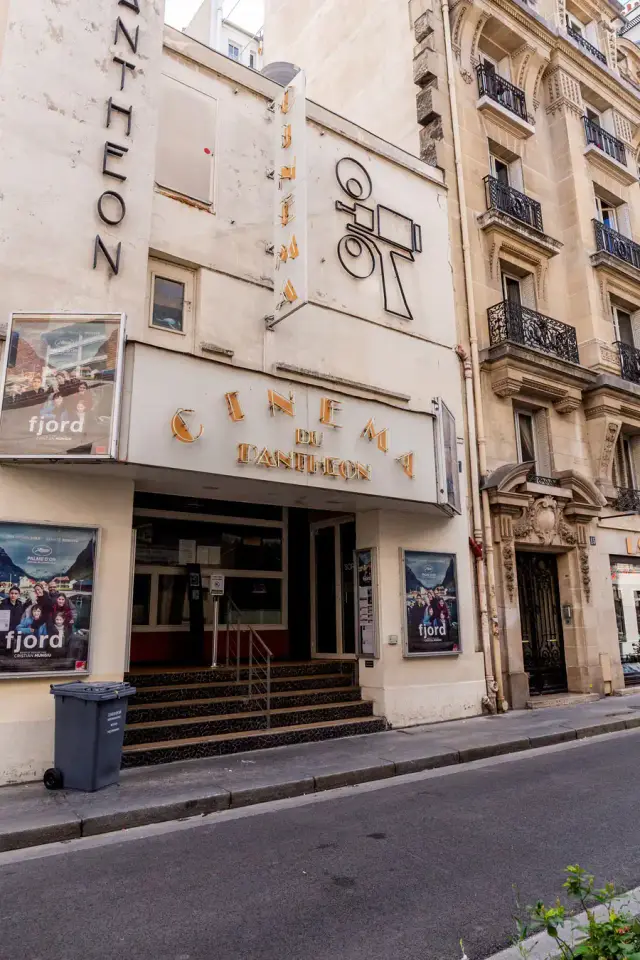
Cinema attendance did not fall during the occupation. It rose. France sold more than 300 million cinema tickets in 1943 — a record that stood for decades. Theaters were full, music halls were full. Edith Piaf was singing. Django Reinhardt was playing jazz in a city whose occupiers had officially condemned jazz as degenerate, and playing it to packed rooms.
Some of what Parisians watched was made by the occupier: Continental Films, a German-owned production company founded in Paris in October 1940, produced around thirty French films with French stars and French directors. And every screening opened with the newsreels, the actualites, which is where the darkness of the cinema became politically useful. Audiences jeered, coughed, and scraped their feet during German news items, safely anonymous — until the authorities began leaving the house lights on during the newsreels.
There was also a youth subculture. The zazous — oversized checked jackets, long hair, thick-soled shoes, an aggressive enthusiasm for swing music — were doing nothing overtly political, which is precisely why the collaborationist press attacked them so furiously. Not resisting and not obeying was itself a category.
None of this means Paris was having a good war. It means people continued to be people while the deportations were happening a few streets away, and that is a more uncomfortable fact than outright collaboration.
School, Children, and the Yellow Star
Schools reopened in the autumn of 1940. There was a portrait of Marshal Petain in the classroom and a song, Marechal, nous voila, to go with it.
Then, on June 7, 1942, Jewish children aged six and over were required to wear the yellow star, obtained at the local police station at the cost of one textile coupon for three stars. They went to school wearing it. Some teachers seated them at the front in protest, some classmates turned away, and within weeks of the Vel’ d’Hiv roundup of July 16-17, 1942, chairs in those classrooms were empty.
More than 11,000 Jewish children were deported from France. This is the one piece of occupation history you cannot avoid in Paris today, because since the late 1990s almost every school in the city carries a plaque at its entrance naming the pupils of that school who were taken. Most people walk past them. Once you have read one, you see them everywhere.
Radio, Newspapers, and the Walls
The press belonged to the occupier. Le Matin, Paris-Soir — its title stolen from its own pre-war editors — and the openly fascist Je suis partout printed what the Propaganda-Abteilung wanted printed.
So the real information war happened on the radio, at low volume, behind closed shutters. Listening to the BBC’s French service was illegal and widely practiced; the Germans jammed it, and Parisians learned to find it through the noise. Radio-Paris, the collaborationist station, was demolished nightly by a jingle broadcast from London: “Radio-Paris ment, Radio-Paris est allemand” — Radio-Paris lies, Radio-Paris is German.
There was also clandestine print. The very first network to publish an underground newspaper in Paris formed around the Musee de l’Homme, and its story — Agnes Humbert kept a journal of it — shows how small and how fatally amateur early resistance was.
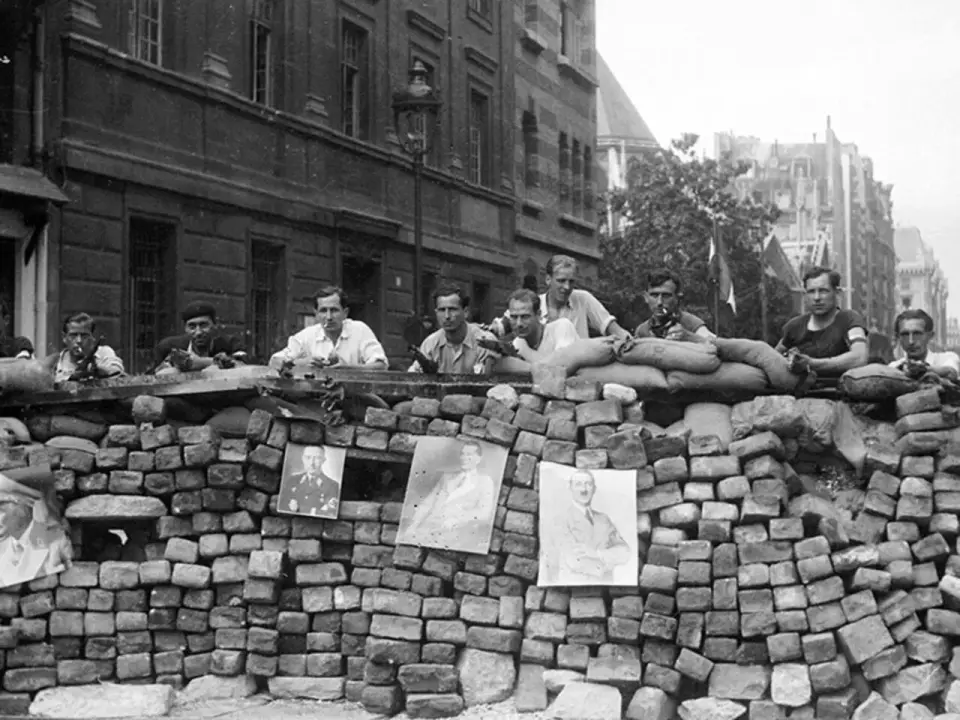
And then there were the walls. The occupation communicated by placard: lists of executed hostages, posted in black on white, and in February 1944 the most famous propaganda poster of the war, the Affiche Rouge, showing ten members of the Manouchian group as foreign terrorists. Parisians wrote “Mort pour la France” across them in the night.
What Is Left in the Streets
Almost none of this is in a museum. It is in the fabric of the city.
The plaques on the schools. The ici est tombe markers where fighters died during the Liberation in August 1944. The bullet holes still visible on facades in the Latin Quarter. The closed Metro stations. The hour on the clock.
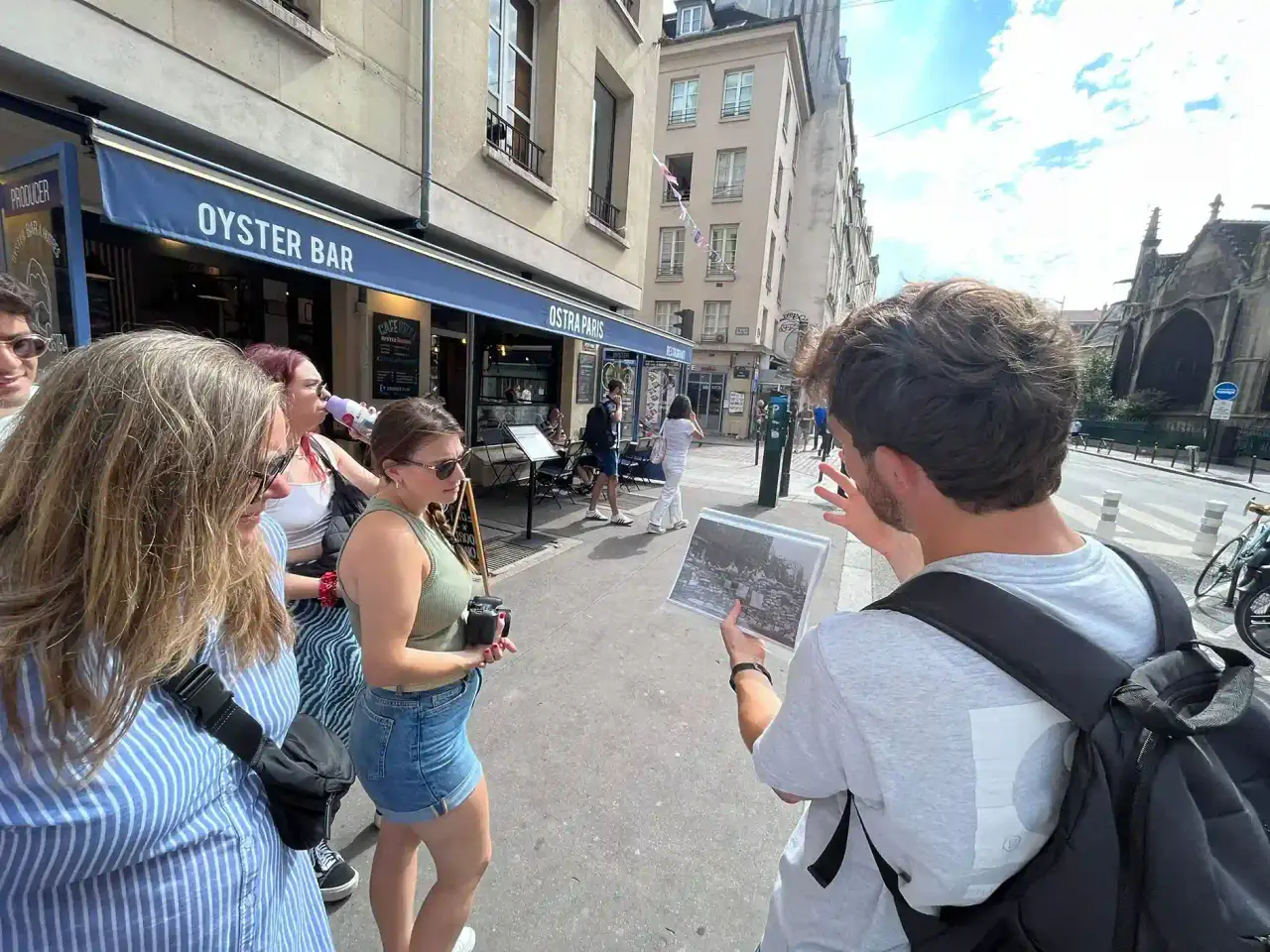
On my Left Bank walking tour and Right Bank walking tour, this is what I spend most of the time on — not the strategy, but the street: the bakery where the queue formed, the school with the plaque, the cinema that was full every night of a war. If you would rather walk it at your own pace, the self-guided audio tour covers the Left Bank route with the same stops.
Four years is a long time. Most of it was not history being made. It was people getting through the week.