The Writer Who Went to War
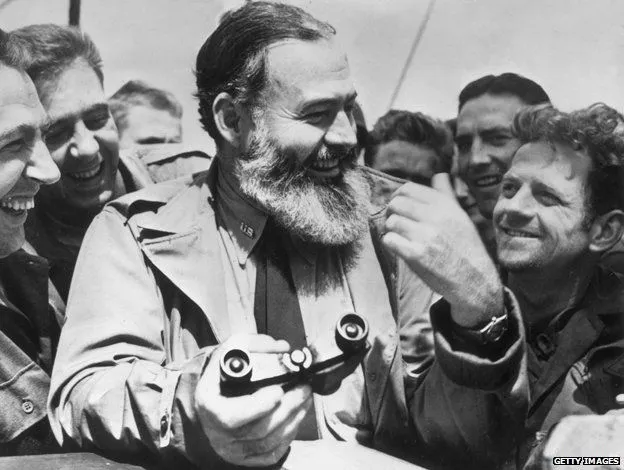
By the summer of 1944, Ernest Hemingway was already one of America’s most famous writers. The Sun Also Rises, A Farewell to Arms, and For Whom the Bell Tolls had cemented his literary reputation.
But Hemingway wasn’t content to observe the war from a distance — he wanted to be in the thick of it.
Accredited as a war correspondent for Collier’s magazine, Hemingway arrived in Normandy shortly after D-Day. He quickly blurred the line between reporter and combatant, attaching himself to the French Resistance forces operating ahead of the main Allied advance toward Paris.
The Race for Paris
As the Allies approached Paris in late August 1944, Hemingway found himself embedded with a group of French Forces Françaises de l’Intérieur (FFI) fighters. By some accounts, he was actively participating in the fighting — a violation of the Geneva Convention’s rules for war correspondents.
On August 25, 1944, as Allied and Resistance forces fought their way into the city, Hemingway had a very specific objective in mind.
While General Leclerc’s 2nd Armored Division was liberating key strategic points and de Gaulle was preparing his triumphant entry, Hemingway headed straight for the Ritz Hotel on Place Vendôme.
”Liberating” the Ritz
The story, as Hemingway told it, goes like this: he arrived at the Ritz with a small band of Resistance fighters, found the hotel mostly abandoned by its German occupants, and proceeded to “liberate” the bar.
He reportedly ordered 73 dry martinis for his companions.
The reality was likely more nuanced. The hotel’s manager, Claude Auzello, had already ensured that the few remaining German officers left peacefully. By the time Hemingway arrived, there was little liberating to do — but plenty of celebrating.
What is not in dispute is that Hemingway essentially moved into the Ritz for several months after the Liberation, occupying a suite and holding court at the bar.
The hotel’s Bar Hemingway, which still exists today on Rue Cambon, is named in his honor.
Place Vendôme: Witness to History
Place Vendôme itself played a significant role in the occupation and liberation of Paris. During the German occupation, the square — with its luxury hotels and jewelers — was a center of German social life in Paris.
The Ritz hosted high-ranking Nazi officers, and the square’s elegant surroundings provided a stark contrast to the suffering of occupied Paris.
On the day of Liberation, fighting broke out near the square. Snipers fired from rooftops, and the transition from occupation to freedom was far from peaceful.
The Place Vendôme we see today, with its gleaming facades and luxury boutiques, bears few visible traces of that violent chapter.
Fact vs. Legend
Hemingway was a master storyteller, and he embellished his wartime exploits considerably.
He was later investigated by the U.S. Army for violating the Geneva Convention by bearing arms as a correspondent — charges he denied by claiming he merely “advised” the Resistance fighters.
What remains true is that Hemingway’s deep love for Paris, dating back to his years as a young expatriate in the 1920s, made the city’s liberation deeply personal for him.
His memoir A Moveable Feast, published posthumously in 1964, captures the Paris he first fell in love with — and helps explain why he was so determined to be present when it was freed.
Walk in Hemingway’s Footsteps
The story of Hemingway’s arrival at Place Vendôme is the dramatic finale of our Right Bank WWII Tour. Standing at the square itself, we bring to life the chaos and celebration of Liberation day — the snipers, the fighters, and the writer who wanted nothing more than a stiff drink at his favorite hotel.
Walk in their footsteps — Book a WWII tour in Paris.